NeuroPaceResponsive neurostimulation for the treatment of epilepsy
About UsProductClinical TrialsResourcesPDMSContact Us


Clinical Trials Print Version

Overview
Epilepsy is a chronic neurological condition affecting over 2.5 million Americans of all ages. Despite treatment with antiepileptic medications, approximately 40-50% of people with epilepsy continue to experience seizures or have intolerable medication side effects. Epilepsy surgery may be an option for some individuals with refractory (hard to treat) epilepsy. However, many people cannot have surgery because it would be too risky and/or is unlikely to be helpful. Consequently, new therapies for epilepsy are needed. Brain devices to treat epilepsy are currently being studied and may offer hope to those persons with epilepsy who are not adequately treated by antiepileptic medication and are not candidates for epilepsy surgery.

What is the purpose of the RNS™ System Pivotal Clinical Investigation?
NeuroPace, Inc. is sponsoring an investigational device study of the RNS System, the company's responsive brain stimulation system for treating refractory epilepsy. The RNS System Pivotal Clinical Investigation is a randomized, double-blind, sham stimulation controlled investigation being conducted at approximately 28 sites throughout the United States. The purpose of the RNS System Pivotal Clinical Investigation is to assess the safety and to demonstrate that the RNS System is effective as an add-on (adjunctive) therapy in reducing the frequency of seizures in individuals 18 years of age or older with partial onset seizures (those that start from one or two areas of the brain) that are refractory (resistant or hard to treat) to two or more antiepileptic medications. Participants in the trial will continue to receive their epilepsy medications.

What is the RNS System?
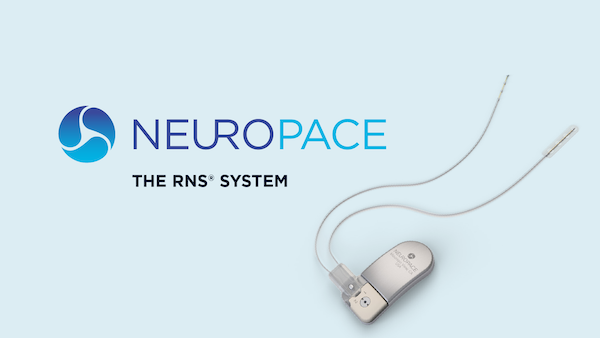
The RNS is designed to detect abnormal electrical activity in the brain and to deliver small amounts of electrical stimulation to suppress seizures before there are any seizure symptoms. The RNS is placed within the skull and underneath the scalp by a surgeon. The RNS is then connected to one or two wires containing electrodes that are placed within the brain or rest on the brain surface in the area of the seizure focus (where seizures start). The RNS is designed to continuously monitor brain electrical activity from the electrodes and, after identifying the "signature" of a seizure's onset, deliver brief and mild electrical stimulation with the intention of suppressing the seizure. This type of treatment is called responsive stimulation, but it is not yet known if it will work for the treatment of epilepsy.

A modified laptop computer known as a programmer communicates with the RNS via a hand-held wand. The programmer collects information from the RNS about brain electrical activity and is used to program the RNS to make detections and deliver responsive stimulation.

How Long Does the Clinical Trial Last and How is the Study Designed?
Study participation is expected to last approximately two to three years depending on when the eligibility criteria is met for implantation of the RNS.

After enrolling in the study, participants first complete the baseline period, which lasts a minimum of three months and a maximum of 15 months. During this part of the study, participants will be given a seizure diary to keep track of their seizures on a daily basis. The doctor in charge of the study will review the frequency and severity of seizures during monthly telephone calls or office visits. Study participants must have an average of three seizures for three consecutive months to be eligible for implantation of the RNS.

Once the eligibility criteria have been met, participants will be implanted with the RNS. Study doctors will check on a participant's physical and emotional health and manage the RNS during regularly scheduled follow-up visits. Participants will continue to keep a daily seizure diary.

The RNS System Pivotal Clinical Investigation is a randomized, double-blind, sham stimulation controlled investigation. The double-blinded portion of the trial begins 28 days after the RNS is implanted and lasts about four months. Half of the participants will be randomly assigned (by chance) to have responsive stimulation turned ON and half will have responsive stimulation turned OFF (sham-stimulation). Participants and one doctor in the trial will not know whether stimulation is being delivered or not. Another doctor will program the RNS. Five months after the RNS has been implanted, when the double-blinded portion of the trial is completed, all participants will be able to have stimulation turned ON.

What Previous Clinical Research has been done with the RNS System?
Previous research has shown that electrical stimulation of the brain can stop seizure activity. Here is an example of the brain's electrical activity showing the use of electrical stimulation to stop a seizure in someone's brain (Figure 1)*.

* Bergey, GB, et.al., Implementation of an external responsive neurostimulator system (eRNS) in patients with intractable epilepsy undergoing intracranial seizure monitoring. Epilepsia Vol 43, Suppl 7, 2002

What are the Risks of Participating in the Clinical Trial?
Clinical trials involve risks. There may be side effects or adverse reactions to the device or therapy, or the therapy may make seizures worse. Implant of the RNS requires brain surgery; as with any type of surgery there is risk involved. Any person involved in this study will be given an informed consent form that describes all known risks. As there is limited experience with the RNS System, there may also be other risks that are currently unknown. Prior to participation in a clinical study, it is always important to discuss the clinical trial procedures, risks, and potential benefits of any procedure or operation in more detail with the physician at the clinical trial site.

Who is Eligible to Participate in the Clinical Trial?
Individuals who have been diagnosed with partial onset epilepsy (those that start from one or two areas of the brain) and have an average of three seizures per month that have not been controlled by taking two or more antiepileptic medications may be eligible to participate in this study. For more information about eligibility criteria, see the Inclusion/Exclusion criteria below or contact the closest participating center.

Inclusion/Exclusion Criteria

Inclusion Criteria

  1. Disabling motor simple partial seizures, complex partial seizures, and/or secondarily generalized seizures. Disabling refers to seizures that are severe enough to cause injuries, or significantly impair functional abilities in areas such as employment, psychological or social wellbeing, education or mobility.
  2. Failed treatment with a minimum of two antiepileptic medications.
  3. Experienced an average of three or more disabling motor simple partial seizures, complex partial seizures and/or secondarily generalized seizures every 28 days for three consecutive 28-day periods.
  4. Between the ages of 18 and 70 years.
  5. No more than two epileptogenic regions in the brain.

Note: Persons implanted with a vagus nerve stimulator (VNS) may be eligible for the RNS trial if the VNS is turned off for a period of time and the person is willing to have the VNS generator explanted (excluding leads) prior to or at the time of the RNS implant.

What should I do to find out more about the RNS Clinical Trial?
If you would like more information about the trial, you can contact a study center directly. You may also contact NeuroPace for more information about the trial and for contact information for other participating study centers. The personnel at a study center can explain the trial in detail and assess if you are a candidate for the trial.

A list of some of the participating study centers is provided below.

Participating Institutions
The following sites are currently enrolling patients in this study. There may be other study sites that are not listed. You may contact NeuroPace for a complete list.

Institution Location Primary Contact Epilepsy Center
University of Southern California Los Angeles, CA Sandra Oviedo
(323) 442-5890
http://www.usc.edu/
schools/medicine/
departments/neurology/
epilepsy/index.html
California Pacific Medical Center San Francisco, CA David King-
Stephens, MD
(415) 600-7880
d.king-stephens
@att.net
http://www.cpmc.org/
epilepsy/
Yale University School of Medicine New Haven, CT Susan S. Spencer, MD
Robert B. Duckrow, MD
(203) 785-3865
 
George Washington University Washington, DC James Leiphart, MD, Ph.D.
202-741-2750
Peg Fender,
MPH
Clinical Research Coordinator
(202) 741-2603
http://www.gwdocs.
com/services/eHA-eHA_
Content_C-Generic_C
ontent_Page_Template_
EpilepsyCenter.html
Mayo Clinic - Jacksonville Jacksonville, FL Karey Doll, RN PhD
(904) 953-6847
doll.karey@mayo
.edu
http://www.mayoclinic.
org/epilepsy/
jaxtreatment.html
Medical College of Georgia Augusta, GA Patty Ray, PhD
(706) 721-6260
pray@mcg.edu
http://www.mcghealth.
org/Health_Services/
Neuroscience_Center/
Epilepsy/index.html
Rush University Medical Center Chicago, IL Deborah Zielinski
(312) 942-5939
http://www.rush.edu/
rumc/page-109961
1538227.html
Indiana University Indianapolis, IN Marsha Manley,
RNA
(317) 274-0176 or
(317) 274-0184
http://indianaepilepsy
services.iusm.iu.edu/
iucomprehensive
epilepsycenter.htm
Via Christi Comprehensive Epilepsy Center Wichita, KS Kore Liow, MD or Toni Sadler, PA-C vcEpilepsyResearch
@via-christi.org
http://www.via-
christi.org/
epilepsy
Massachusetts General Hospital Boston, MA Justine Cormier
(617) 726-5904
jecormier@
partners.org
http://www.seizure.org/
Johns Hopkins University Baltimore, MD Gregory Bergey, MD
(410) 955-7338
ext. 4
gbergey@jhmi.edu
http://www.neuro.
jhmi.edu/epilepsy/
Henry Ford Hospital Detroit, MI Gregory Barkley, MD
Brien Smith, MD
(313) 916-2451
http://www.henryford
health.org/body.cfm?id
=45102
Mayo Clinic - Rochester Rochester, MN Karla Crockett
(507) 284-2511
crockett.karla
@mayo.edu
http://www.mayoclinic
.org/epilepsy/rst
treatment.html
Dartmouth-Hitchcock Medical Center Lebanon, NH Barbara Jobst, MD and Emily Clough
(603) 650-6244
Barbara.Jobst@
hitchcock.org

Emily.R.Clough@
dartmouth.edu
http://www.dhmc.org/
webpage.cfm?
site_id=2&org_id=128&
gsec_id=0&sec_id=0&
item_id=3480
University of Rochester Rochester, NY Karen Sarosky,
CRC
(585) 275-0589
karen_sarosky@
urmc.rochster.edu
www.stronghealth.com/
services/neurology/
epilepsy/index.cfm
Oregon Health & Science University Portland, OR Rebecca Hoffenberg
(503) 494-9633
hoffenbe@ohsu.edu
http://www.ohsu.edu/
epilepsy
Baylor College of Medicine Houston, TX Eli M. Mizrahi, MD
(713) 798-0980
emizrahi@bcm.
tmc.edu
http://www.Baylor
EpilepsyCenter.org
University of Virginia Charlottesville, VA Stacy R. Thompson,
RN, BSN, CCRC
(434) 982-4315
SRC2H@hscmail.
mcc.virginia.edu
 
Swedish Medical Center Seattle, WA Epilepsy Center Research
Project Coordinator
(206) 320-2261 or
(206) 215-3565
http://www.swedish.org/
body.cfm?id=158
University of Wisconsin School of Medicine and Public Health Madison, WI Talley Mitchell
(608) 263-1739
tmmitchell@clinical
trials.wisc.edu
http://www.neurology.
wisc.edu

Caution: The RNS™ System is an Investigational device. Limited by United States law to investigational use.

To learn more about clinical trials, visit:
ClinicalTrials.gov
U.S. Food and Drug Administration

Print Version

Return to Top